Moving from Amazon and Flipkart to Your Own Online Store
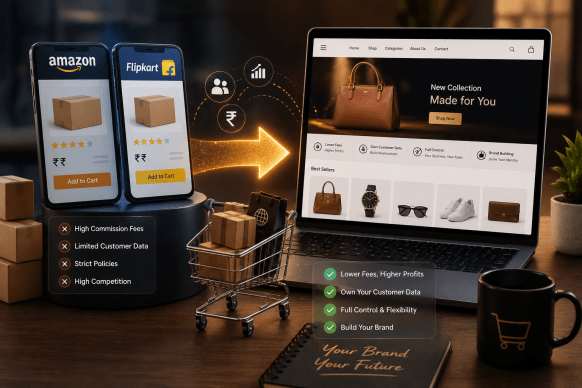
Moving from Amazon and Flipkart to your own online store is a milestone many Indian sellers reach the moment the marketplace commissions start to sting. You built the sales, you fulfilled the orders, you earned the reviews — yet a big slice of every rupee still walks out the door in fees, and you don't even get to keep the customer's contact details.
Owning your store changes that equation. Better margins, direct customer relationships, full control over branding, and freedom from sudden policy changes that can tank your listings overnight. It's the natural next step for any seller serious about building a lasting business.
But it's not a switch you flip carelessly. This guide covers how to make the move smartly — what to keep, what to migrate, and how to bring your marketplace customers over to a store you actually own.
Definition Box
What does moving to your own store mean?
It means shifting your primary sales channel from third-party marketplaces to a branded online store you control — with your own domain, checkout, payments, and customer data — while often keeping marketplaces as a secondary discovery channel rather than your whole business.
- You own the domain, brand, and checkout experience.
- You keep customer emails and phone numbers.
- You escape high marketplace commissions.
- You're insulated from sudden platform policy changes.
Quick Facts: Moving to Your Own Store
| Main reason to move | Keep more margin and own the customer |
| Typical fee saved | 15% to 30% marketplace commission |
| Setup time | A few days to a couple of weeks |
| Must-have | Custom domain and UPI or card payments |
| Biggest challenge | Driving your own traffic |
| Smart approach | Keep marketplaces as a secondary channel |
| Key win | A repeat-buying, owned customer base |
Don't Abandon Marketplaces Overnight
The smartest move isn't to quit Amazon and Flipkart on day one — it's to build your store while the marketplaces still bring in sales, then gradually shift the balance. Cut the cord too early and you starve your cash flow before your store has traffic.
Bring the customer with you
Every marketplace order is a chance to introduce your store. A thank-you card with a discount code, a QR to your site, a follow-up on social — these nudges move buyers from a channel you rent to one you own.
- Add a branded insert with a store offer in every parcel.
- Build an email and WhatsApp list from your own store orders.
- Run store-only launches and loyalty perks to pull buyers over.
Marketplace vs Your Own Store
Seeing the trade-offs side by side makes the case for owning your store obvious, while reminding you what marketplaces still do well.
| Your Own Store | Marketplace |
|---|---|
| Keep almost all the revenue | Lose 15% to 30% in commission |
| Own customer contact details | No access to customer data |
| Stable, policy-proof business | Vulnerable to sudden rule changes |
| You bring the traffic | Traffic comes built in |
Setting up doesn't need to be daunting. With Webilns you get a storefront builder, a custom domain, UPI and card payments, and GST-compliant invoicing in one place. Have a look at the pricing to see how the savings stack up against marketplace fees.
Common Mistakes When Making the Move
Plenty of sellers stumble in the transition. Avoid these and your move to your own store will be far smoother.
- Quitting marketplaces before the store has any traffic.
- Forgetting to set up proper GST-compliant invoicing.
- Offering fewer payment options than the marketplace did.
- Not capturing customer contacts to remarket later.
- Expecting instant sales without any marketing effort.
Frequently Asked Questions
1. Should I completely leave Amazon and Flipkart?
Usually not. Keep them as a secondary discovery channel while making your own store the primary one. That way you keep marketplace reach without depending on it for survival.
2. How do I move my marketplace customers to my store?
Use parcel inserts, discount codes, QR links, and social follow-ups. You can't export marketplace data, but every order is a chance to invite the buyer to your own store.
3. Will I lose sales when I move?
Not if you transition gradually. Keep marketplaces running while you build store traffic through marketing, then let the higher-margin store channel grow over time.
4. Is a custom domain really necessary?
Yes. Your own domain builds trust and brand recall, and it's yours forever. It signals you're a real business, not a temporary listing that could vanish.
5. How do I handle GST on my own store?
Pick a platform with built-in GST-compliant invoicing and reports. It generates correct tax invoices automatically and makes filing far simpler than reconciling marketplace payouts.
Conclusion
Moving from Amazon and Flipkart to your own online store is one of the highest-leverage decisions a growing seller can make. You reclaim your margins, own the customer relationship, and build a business that no policy change can pull the rug out from under.
Do it gradually, keep the marketplaces working while you grow, and bring your customers along with genuine value. With a storefront, custom domain, payments, and GST invoicing ready to go on Webilns, the move is easier than you think — and the payoff compounds every month.