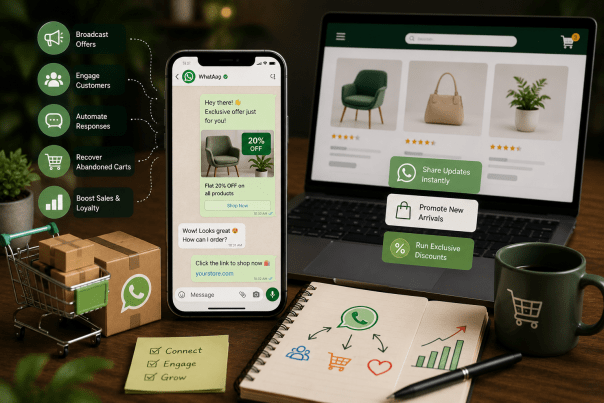
WhatsApp Marketing for Online Stores: A Practical Guide
WhatsApp marketing for online stores isn't a nice-to-have in India, it's where most of your customers already are. With more than 500 million Indians on WhatsApp, it's the one app people check dozens of times a day. For a small store, that's a direct line to your buyers that costs almost nothing.
But there's a right way and a wrong way. Blast random offers and you'll get blocked. Send timely, useful, personal messages and you'll build a channel that quietly outperforms email and paid ads combined.
This guide breaks down how to use WhatsApp to win orders, recover abandoned carts, and keep customers coming back, without being that seller everyone mutes.
Definition Box
What is WhatsApp marketing?
WhatsApp marketing is the practice of using WhatsApp, usually the free Business app or the official Business API, to promote products, send order updates, answer questions, and nurture customer relationships. For online stores, it turns a chat app into a sales and support channel.
Unlike a marketplace listing, WhatsApp is a two-way, personal conversation. That intimacy is exactly why it works, and why it must be used with care. The core building blocks are:
- A WhatsApp Business profile with catalogue and hours
- Broadcast lists or the API for reaching many people at once
- Quick replies and templates to save time
- Opt-in from customers so your messages are welcome
Quick Facts: WhatsApp Marketing in India
| Tool to start with | WhatsApp Business app (free) |
| For scale | WhatsApp Business API via a provider |
| Typical open rate | Often 90%+, far above email |
| Best use cases | Order updates, cart recovery, offers, support |
| Rule to follow | Only message people who opted in |
| Broadcast list limit | 256 contacts per list on the free app |
| Biggest risk | Getting reported and blocked for spam |
Build Your List the Right Way
The single most important rule is consent. Never buy contact lists or scrape numbers. Instead, collect opt-ins naturally so every message you send lands with someone who wants to hear from you.
Easy ways to get opt-ins
- Add a "Chat on WhatsApp" button to your storefront
- Offer a small first-order discount for joining your updates
- Ask at checkout whether they want order updates on WhatsApp
- Share a click-to-chat link in your Instagram bio and Stories
Messages That Drive Sales
Not every message should sell. Mix helpful updates with the occasional offer so people stay subscribed. Order confirmations and shipping updates build trust; they also open the door to gentle upsells later.
When you do promote, keep it short and specific. "New cotton kurtis just dropped, only 20 pieces, tap to order" beats a wall of text. And always give a clear link so buyers can check out in seconds instead of asking "how to buy?" in reply.
Business App vs Business API
Which version of WhatsApp Business you use depends on your order volume. Here's a quick comparison to help you decide.
| WhatsApp Business App | WhatsApp Business API |
|---|---|
| Free, works on one phone | Paid per conversation, works across a team |
| Manual broadcasts up to 256 at a time | Automated bulk messaging with templates |
| Great for solo sellers and small shops | Built for high-volume stores |
| No chatbots or CRM integration | Supports bots, CRM, and analytics |
| Set up in minutes | Needs a provider and approval |
Whichever you pick, WhatsApp works best when it connects to a real store. With Webilns, you can send buyers a checkout link, take UPI payments, and generate GST invoices automatically, so a WhatsApp chat turns into a paid, recorded order without manual follow-up.
Common Mistakes to Avoid
- Messaging people who never opted in, which gets you reported fast
- Sending five promotions a day until everyone mutes you
- Copy-pasting the same generic message with no personalisation
- Leaving questions unanswered for hours during buying hours
- Forgetting to include a direct checkout or product link
Frequently Asked Questions
1. Is WhatsApp marketing legal in India?
Yes, as long as you message people who have opted in and you follow WhatsApp's business policy. Sending unsolicited bulk messages can get your number banned.
2. How often should I message my customers?
A good rhythm is one to two promotional messages a week, plus transactional updates as they happen. Watch your unsubscribe and block rates and adjust.
3. Do I need the paid API to start?
No. The free WhatsApp Business app is enough for most small stores. Move to the API only when broadcasts and team support become a bottleneck.
4. Can I recover abandoned carts on WhatsApp?
Absolutely. A friendly reminder with the product and a checkout link often brings back buyers who got distracted, one of WhatsApp's highest-return uses.
5. How do I add a catalogue?
The Business app lets you add products with photos and prices under your profile. Buyers can browse and message you directly about any item.
Conclusion
WhatsApp is the most personal marketing channel you have, and in India it's practically universal. Treat it with respect, message only people who want to hear from you, and lead with helpfulness, and it becomes a steady source of repeat orders.
Connect those chats to a proper store so payments and invoices happen automatically, and you get the best of both worlds: the warmth of a one-to-one conversation and the reliability of real eCommerce. That combination is hard for any big marketplace to beat.