Do You Need to Register a Business to Sell Online in India?
One of the first questions every new founder asks is whether you need to register a business to sell online in India. The honest answer? You can start selling faster than you think, but a few registrations quietly decide how far you can grow, how you get paid, and how much trust buyers place in you.
Plenty of people launch a store as a sole proprietor with almost no paperwork. Others jump straight to a private limited company. Neither is automatically right. It depends on what you sell, how much you expect to earn, and whether you want outside investment down the line.
Let's clear the fog so you can start selling without accidentally skipping something important.
Definition Box
What is business registration for online selling?
Business registration is the legal recognition of your selling activity — as a sole proprietor, partnership, LLP, or company. It gives you a legal identity to open a current account, sign vendor agreements, and pay taxes correctly.
In India there's no single national business licence. Instead you build up a stack of registrations depending on your model and scale.
- Sole proprietorship is the simplest and needs the least paperwork.
- A current bank account usually needs some proof of business.
- GST and other registrations depend on turnover and category.
The Short Answer: It Depends on Scale
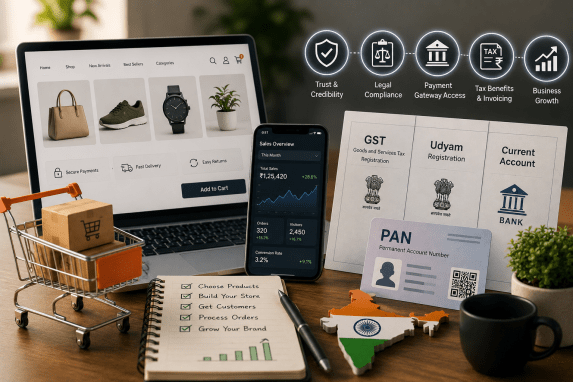
If you're testing an idea with a handful of orders, you can operate as a sole proprietor without formally incorporating anything. Your PAN and a few basic documents are often enough to get moving on your own storefront and start accepting UPI payments.
But once money starts flowing, banks, marketplaces, and payment gateways start asking for proof. That's when registrations stop being optional. Think of registration as a ladder — you climb a rung each time your business outgrows the previous setup.
Quick Facts: Selling Online Legally
| Simplest structure | Sole proprietorship |
| Needed for a current account | Proof of business (GST, Udyam, etc.) |
| Small business ID | Udyam (MSME) registration, free |
| Tax ID | GSTIN when thresholds apply |
| For investors | Private limited company |
| Food category extra | FSSAI licence |
| Setup time | A few days to a couple of weeks |
Which Business Structure Fits You?
| Structure | Best For |
|---|---|
| Sole Proprietorship | Solo founders testing an idea, low compliance |
| Partnership / LLP | Two or more co-founders sharing risk |
| Private Limited | Brands raising funds or scaling fast |
| One Person Company | Solo founders wanting limited liability |
Category-specific licences
Some products carry their own rules no matter your structure. Selling food needs an FSSAI licence. Cosmetics, electronics, and certain imports have their own norms. Check your category before you list, because a missing licence can get products pulled overnight.
Getting Set Up to Actually Sell
Registration is only half the story. You also need a place to sell and a way to collect money. This is where a storefront platform saves weeks. With Webilns you can build a branded online store, put it on a custom domain, and accept UPI and card payments without stitching together five different tools.
If you also sell offline, the same setup handles counter billing, so your online and in-store sales sit in one place. That unified view makes tax time and bookkeeping dramatically easier.
Common Mistakes New Sellers Make
- Mixing personal and business money in one bank account.
- Over-registering too early and paying for compliance they don't need yet.
- Skipping category licences like FSSAI and getting listings removed.
- Ignoring Udyam registration, which unlocks easy MSME benefits for free.
- Choosing a company structure they don't need, then drowning in filings.
Frequently Asked Questions
1. Can I sell online without registering a company?
Yes. Many sellers start as sole proprietors using their PAN. You only need a formal company if you want limited liability or plan to raise funding.
2. Do I need GST to start?
Not always. It depends on your turnover and whether you sell through a marketplace that collects TCS. Selling on your own store under the threshold may not require it immediately.
3. What is Udyam registration?
It's a free MSME registration that gives your small business an official identity and access to schemes, easier loans, and certain protections. It's quick to do online.
4. How do I open a current account?
Banks usually ask for proof of business such as a GST certificate, Udyam registration, or shop licence, along with your PAN and KYC documents.
5. Is a sole proprietorship risky?
Your personal and business liabilities aren't separated, so debts fall on you personally. For low-risk small stores it's fine; for bigger operations consider an LLP or private limited.
6. Can I upgrade my structure later?
Absolutely. Most founders start simple and convert to an LLP or company once revenue and complexity justify it. Start lean and grow into it.
Conclusion
You don't need a fancy company to start selling online in India. You need a clear structure that matches your scale, the right licences for your category, and a clean way to take payments. Begin as a proprietor if that's all you need, and climb the ladder as you grow.
The paperwork matters less than momentum. Get a store live, start taking orders, and add registrations as they become necessary. See our FAQs if you have setup questions.
The best time to start was yesterday. The second best time is right now, with a store you actually control.