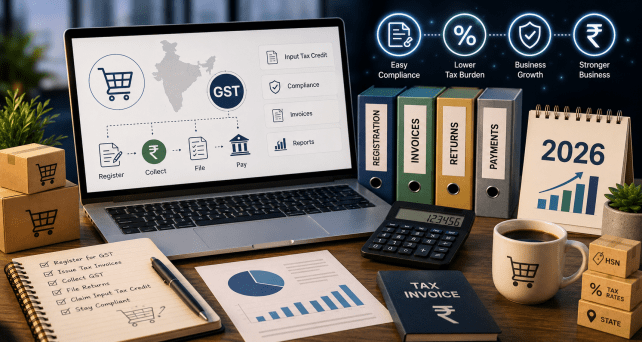
GST for Online Sellers in India: The Simple 2026 Guide
If you sell online in India, GST for online sellers is probably the one thing that keeps you up at night. You start a small store, orders begin trickling in, and suddenly there's talk of GSTIN, invoices, returns, and something called TCS. It sounds scarier than it actually is. Once you understand the basics, GST becomes a routine part of running your business, not a monster hiding under the bed.
This guide keeps things practical for 2026. Whether you're selling on your own website, a marketplace, or both, we'll walk through when you need to register, how invoicing works, and the mistakes that trip up first-time sellers. No jargon dumps, just what you actually need.
By the end, you'll know exactly where you stand and what to do next. Let's get into it.
Definition Box
What is GST for online sellers?
GST (Goods and Services Tax) is India's unified indirect tax on the supply of goods and services. For online sellers, it means charging tax on your sales, collecting a valid GSTIN, issuing compliant invoices, and filing periodic returns with the government.
In plain terms, you become a collection point. You add GST to your prices, hand that tax over to the government, and claim back the GST you paid on your own purchases (called input tax credit).
- GSTIN is your 15-digit GST identification number.
- Marketplaces deduct TCS (Tax Collected at Source) before paying you.
- Returns like GSTR-1 and GSTR-3B are filed monthly or quarterly.
Do You Actually Need GST Registration?
Here's where a lot of confusion lives. For a regular business, the GST registration threshold is ₹40 lakh turnover for goods and ₹20 lakh for services (₹20 lakh and ₹10 lakh in special category states). But the moment you sell through a marketplace that collects TCS, the threshold rule changes.
If you sell physical goods through platforms like Amazon or Flipkart, those platforms are treated as e-commerce operators, and in most cases you need GST registration regardless of turnover. Selling only on your own storefront? Then the normal thresholds usually apply, which is why many small D2C brands start on their own site first.
A recent relaxation lets small suppliers selling goods through e-commerce operators skip registration if their turnover stays under the threshold and they sell within a single state, but the conditions are strict. When in doubt, register. It's cheaper than a penalty.
Quick Facts: GST for Sellers in 2026
| Goods threshold | ₹40 lakh (₹20 lakh in special states) |
| Services threshold | ₹20 lakh (₹10 lakh in special states) |
| GSTIN format | 15 digits, PAN-based |
| Common returns | GSTR-1, GSTR-3B |
| TCS rate on marketplaces | 0.5% CGST + 0.5% SGST (1% total) |
| Registration cost | Free on the GST portal |
| Invoice requirement | Mandatory tax invoice with GSTIN |
Invoicing and Returns Without the Headache
Once you're registered, every sale needs a proper tax invoice. That means your GSTIN, the buyer's details, the HSN code for the product, the taxable value, and the GST split. Getting this right by hand across hundreds of orders is where sellers burn out.
This is exactly where good software earns its keep. A platform like Webilns generates GST-compliant invoices automatically and rolls your sales into ready-to-file GST reports, so you're not copying numbers into a spreadsheet at midnight.
CGST, SGST, IGST — the 30-second version
Selling within your own state? You charge CGST plus SGST. Selling to another state? You charge IGST instead. The total rate stays the same, only the split changes based on where the buyer is. Modern billing tools figure this out for you based on the delivery address.
Own Store vs Marketplace: GST Comparison
| Factor | Own Storefront |
|---|---|
| Registration trigger | Normal turnover thresholds usually apply |
| TCS deduction | None on your own site |
| Invoice control | Fully yours, branded |
| Payout timing | Direct via UPI or card gateway |
The takeaway: running your own store gives you cleaner GST handling and faster payouts, which is one reason many sellers keep a self-owned storefront alongside marketplace listings.
Common GST Mistakes Online Sellers Make
- Ignoring registration because sales feel small, then getting hit with back-dated tax.
- Using wrong HSN codes, which mismatches your returns and buyer records.
- Forgetting to reconcile marketplace TCS against their GST portal ledger.
- Missing GSTR-3B deadlines and racking up late fees plus interest.
- Not claiming input tax credit on packaging, ads, and software costs.
Frequently Asked Questions
1. Do I need GST if I only sell on my own website?
If your turnover stays under the threshold and you're not using a marketplace that collects TCS, you may not need to register yet. But registering early lets you claim input credit and looks more professional to buyers.
2. Is GST registration free?
Yes. Registration on the official GST portal costs nothing. You only pay if you hire a consultant to file on your behalf.
3. What is TCS on marketplaces?
Marketplaces deduct 1% (0.5% CGST + 0.5% SGST) from your sale value and deposit it against your GSTIN. You adjust it while filing returns, so it's not a lost cost.
4. How often do I file GST returns?
Most small sellers file GSTR-1 and GSTR-3B monthly, though the QRMP scheme lets eligible businesses file quarterly while paying tax monthly.
5. Can software file GST for me?
Software can prepare accurate reports and export data ready for filing. With Webilns, your sales flow straight into GST-ready reports, cutting hours of manual work each month.
6. What happens if I don't register when required?
You can face penalties, interest, and back-dated tax demands. It's far cheaper to register on time than to clean up a compliance mess later.
Conclusion
GST feels intimidating on day one, but it settles into a rhythm fast. Figure out whether you need to register, issue clean invoices, file on time, and claim the credit you're owed. Do those four things and you're already ahead of most first-time sellers.
The real time-saver is letting your selling platform handle the paperwork. When invoices and GST reports are generated automatically, compliance stops being a chore and becomes a background process. Explore Webilns pricing to see how an all-in-one storefront and billing setup can take GST off your plate.
Start small, stay compliant, and scale with confidence. Your future self, filing returns in ten minutes instead of ten hours, will thank you.