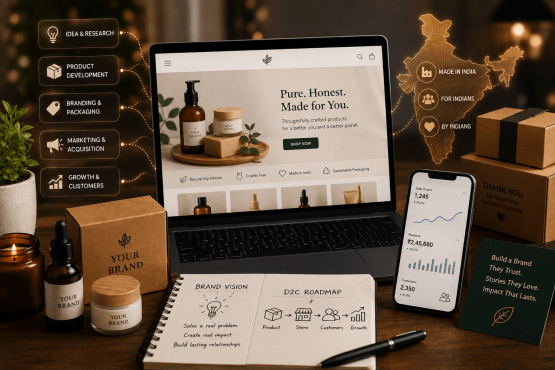
How to Build a D2C Brand in India from Scratch
Learning how to build a D2C brand in India from scratch is one of the most exciting (and nerve-wracking) journeys a founder can take. You're not just selling a product anymore — you own the relationship with your customer, the packaging, the story, and every rupee of margin that used to go to a middleman. That's powerful. But it also means the buck stops with you.
The good news? India has never been a better place to launch a direct-to-consumer brand. UPI adoption is everywhere, logistics reach tier-2 and tier-3 towns, and customers increasingly trust homegrown labels over faceless imports. Brands like boAt, Mamaearth, and countless smaller players proved the playbook works.
This guide walks you through the real, unglamorous steps — from validating your idea to setting up an online store, handling GST, and keeping customers loyal. No fluff, just what actually moves the needle.
Definition Box
What is a D2C brand?
A direct-to-consumer (D2C) brand sells its products straight to customers through its own channels — an online store, social media, or physical outlets — without relying on distributors, wholesalers, or third-party marketplaces as the primary route. You control pricing, branding, customer data, and the entire experience.
- You own the customer relationship and their data.
- Higher margins because there's no middleman markup.
- Full control over how your brand looks and feels.
- Direct feedback loop for faster product improvements.
Quick Facts: Building a D2C Brand in India
| Startup cost | ₹25,000 to ₹2,00,000 depending on category and inventory |
| Time to launch | 2 to 8 weeks for a lean first version |
| GST registration | Mandatory above ₹40 lakh turnover (₹20 lakh for services) |
| Best first channel | Your own online store plus Instagram |
| Payment method | UPI, cards, and net banking |
| Biggest early challenge | Customer acquisition cost |
| Key metric | Repeat purchase rate |
Start with a Problem, Not a Product
Most failed D2C brands started because a founder liked a product idea. The winners started with a problem a specific group of people actually had. Before you spend a rupee on inventory, get clear on who you're serving and why they'd pick you over the ten other options on their phone.
Validate before you invest
Sell a small batch first. Post it on Instagram, take orders on WhatsApp, deliver by hand if you have to. If people pay real money before you've built anything fancy, you've got a signal worth chasing.
- Talk to at least 20 potential customers before committing.
- Run a pre-order to test real demand, not just interest.
- Pick a niche narrow enough to own before going wide.
Set Up Your Online Store and Payments
Your store is your headquarters. Marketplaces rent you customers; your own store lets you keep them. Pick a platform that handles the full stack — storefront, payments, and GST invoicing — so you're not stitching together five tools on day one. With Webilns you get a storefront builder, UPI and card payments, and a custom domain in one place.
Set up UPI, cards, and net banking from the start. Indian shoppers abandon carts fast when their preferred payment option is missing. Check the pricing before you commit so there are no surprises on transaction fees.
D2C store vs marketplace-only: a quick comparison
| Your Own D2C Store | Marketplace Only |
|---|---|
| You keep customer data and emails | Marketplace owns the customer |
| Higher margins, no big commission cut | 15% to 30% commission on every sale |
| Full control of branding | Generic listing template |
| You handle your own traffic | Built-in marketplace footfall |
Common Mistakes New D2C Founders Make
You'll save yourself months of pain by dodging these traps that catch nearly every first-time founder.
- Overspending on branding and packaging before proving demand.
- Ignoring GST-compliant invoicing until it becomes a mess at filing time.
- Chasing vanity metrics like followers instead of repeat buyers.
- Discounting so heavily that there's no margin left to grow.
- Trying to be everywhere at once instead of nailing one channel.
Frequently Asked Questions
1. How much money do I need to start a D2C brand in India?
You can start lean with ₹25,000 to ₹50,000 if you use print-on-demand or small inventory batches. Product-heavy categories like beauty or apparel may need ₹1,00,000 or more for initial stock and packaging.
2. Do I need GST registration to sell online?
If your turnover is below ₹40 lakh you may not need it immediately, but most payment gateways and marketplaces ask for a GSTIN. Registering early makes invoicing and input tax credit far simpler.
3. Should I start on a marketplace or my own store?
Do both, but treat your own store as the priority. Marketplaces give you quick discovery, while your store builds a customer base you actually own and can market to again.
4. How long before a D2C brand becomes profitable?
Many brands take 12 to 24 months to hit consistent profit. Your repeat purchase rate matters more than a viral first month, so focus on retention early.
5. What's the single most important thing to get right?
Product-market fit. If people love the product and come back, everything else — ads, packaging, delivery — becomes solvable. Without it, no amount of marketing helps.
Conclusion
Building a D2C brand in India from scratch isn't about a fancy logo or a viral launch. It's about solving a real problem, keeping your margins healthy, and owning the customer relationship end to end. Start small, validate hard, and reinvest what works.
The tools have never been more accessible. With a proper storefront, integrated UPI and card payments, and GST-ready invoicing, the technical barriers that used to stop founders are gone. What's left is the fun part — building something people love. Ready to take the first step? Explore Webilns and get your store live.