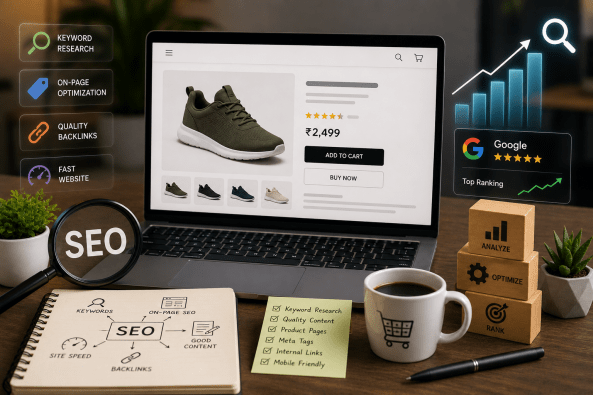
eCommerce SEO Basics: How to Rank Your Online Store on Google
Getting eCommerce SEO basics right is what separates stores that quietly get free traffic every day from stores that depend entirely on paid ads. When someone in India searches "cotton bedsheets online" or "handmade soap near me," you want your store to show up, and that's exactly what search engine optimisation makes possible.
The good news is you don't need to be a technical wizard. A handful of fundamentals, done consistently, will get your product pages ranking on Google over time. And unlike ads, that traffic keeps coming without you paying for every click.
Let's walk through the essentials, in order, so you know exactly where to start and what to fix first.
Definition Box
What is eCommerce SEO?
eCommerce SEO is the process of optimising your online store so it appears higher in search engine results when people look for the products you sell. It covers your keywords, product pages, site speed, structure, and the links pointing to your store.
Done well, it brings in buyers who are already searching for what you offer, which makes them far more likely to purchase than cold ad traffic. The main pillars are:
- Keyword research to learn what buyers type
- On-page SEO on product and category pages
- Technical SEO for speed and crawlability
- Content and links to build authority
Quick Facts: eCommerce SEO
| Cost | Mostly time; no per-click charges |
| Time to results | Usually 3 to 6 months to see traction |
| Most important page | Product and category pages |
| Free tools | Google Search Console and Analytics |
| Ranking factor | Relevance, speed, mobile, and links |
| Local edge | Google Business Profile for "near me" searches |
| Biggest mistake | Thin, copied product descriptions |
Start With Keywords Buyers Actually Type
Before you optimise anything, understand the words your buyers use. Someone shopping rarely searches the way you describe your product internally. They type things like "affordable running shoes for men" or "steel water bottle 1 litre."
Simple keyword research
- Type a product into Google and note the autocomplete suggestions
- Scroll to "People also ask" and "related searches" for ideas
- Target longer, specific phrases; they're easier to rank for
- Use one clear primary keyword per page, not ten crammed together
Optimise Your Product Pages
Your product pages do the heavy lifting. Each one should target a keyword and give Google enough unique information to understand what you're selling. That starts with the title tag and description and runs through the whole page.
Write original descriptions, never paste the manufacturer's copy that a thousand other stores use. Add the primary keyword to the page title, the URL, an image alt text, and naturally through the description. Include size, material, care, and delivery details buyers ask about, because helpful pages rank better and convert better.
SEO vs Paid Ads
Many new sellers ask whether they should invest in SEO or just run ads. The honest answer is both, but they play different roles. Here's how they stack up.
| SEO | Paid Ads |
|---|---|
| Traffic keeps coming after you stop working | Traffic stops the moment you stop paying |
| Slow to build, months to mature | Instant visibility once the ad is live |
| Low ongoing cost | You pay for every single click |
| Builds long-term brand trust | Great for quick launches and testing |
| Compounds over time | Resets every campaign |
A store built on Webilns gives you SEO-friendly pages, clean URLs, fast loading, and your own custom domain, which all help Google trust and rank your site. You can review the plans on the pricing page.
Common Mistakes to Avoid
- Copying product descriptions instead of writing your own
- Ignoring mobile speed when most Indian shoppers are on phones
- Stuffing keywords until the text reads like a robot wrote it
- Forgetting image alt text and descriptive file names
- Never setting up Google Search Console to track progress
Frequently Asked Questions
1. How long does eCommerce SEO take to work?
For a new store, expect three to six months before you see steady organic traffic. Established sites with good content can move faster.
2. Do I need a blog for SEO?
A blog helps you target questions and informational searches that product pages can't. It's not mandatory, but it's one of the best long-term traffic sources.
3. Does site speed really matter?
Yes. Slow pages frustrate shoppers and Google ranks them lower, especially on mobile. A fast, well-built store has a real advantage.
4. What about local SEO?
If you serve a city or area, set up a Google Business Profile and mention your location naturally. It helps you show up for "near me" searches.
5. Can I do SEO myself?
Absolutely. The basics in this guide are all doable without an agency. Start with keywords and product pages, then expand as you learn.
Conclusion
eCommerce SEO isn't magic, it's a steady set of habits: understand what buyers search, write genuinely useful product pages, keep your store fast, and earn trust over time. Do that, and Google rewards you with visitors who are ready to buy.
Start with the fundamentals in this guide and pick a platform that gives you clean, fast, SEO-ready pages from day one. The traffic you build this way compounds month after month, becoming one of the most valuable assets your store owns.