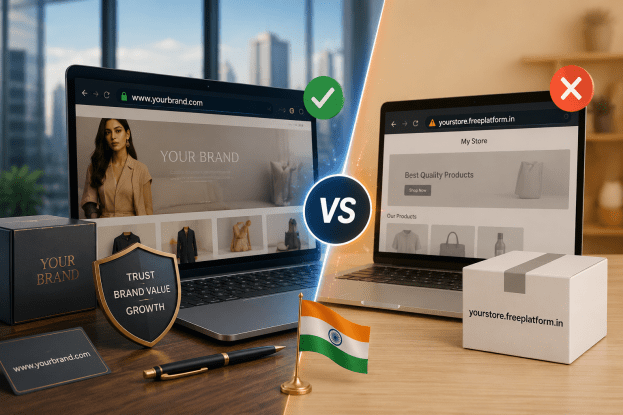
Custom Domain vs Free Subdomain: What Indian Sellers Should Pick
The custom domain vs free subdomain debate trips up almost every new Indian seller at some point. You've built your store, added products, and you're ready to share the link — then you notice your address looks like yourstore.someplatform.com instead of a clean yourstore.com. Does it matter? For your brand and your sales, it matters more than you'd think.
A free subdomain gets you online fast at zero cost, which is genuinely useful when you're testing an idea. But a custom domain — your own .com or .in — signals that you're a real business, and that signal quietly influences whether a stranger trusts you enough to pay.
Let's break down the real differences, what each costs, and which one makes sense at your stage.
Definition Box
What is a custom domain vs a subdomain?
A custom domain is a web address you own outright, like yourbrand.in. A free subdomain is an address hosted under a platform's domain, like yourbrand.platform.com. Both point to the same store, but they say very different things about your business.
- Custom domain: fully yours, portable, brandable.
- Subdomain: free, instant, but tied to the platform's name.
- Both can run a full store with payments and checkout.
- Only the custom domain moves with you if you switch platforms.
Quick Facts: Domains for Indian Sellers
| Custom domain cost | A modest yearly registration fee |
| Subdomain cost | Free with the platform |
| Popular endings | .com, .in, .co.in, .store |
| Brand trust | Higher with a custom domain |
| Portability | Custom domain moves with you |
| Setup time | Minutes to buy, a short while to connect |
| Best for testing | Free subdomain |
Why a Custom Domain Wins on Trust
When a customer sees yourbrand.in, they read "established business." When they see a long platform subdomain, some read "hobby" or "not sure this is legit." That perception directly affects whether they hand over payment details.
What a custom domain gives you
- A short, memorable address people can type from a WhatsApp status or a poster.
- Matching email like hello@yourbrand.in, which looks far more professional.
- Full ownership — you keep the name even if you change platforms.
- Cleaner branding on cards, packaging, and ads.
On Webilns you can start on a free subdomain and connect your own custom domain whenever you're ready, so nothing holds you back at launch.
Custom Domain vs Free Subdomain: Side by Side
Here's the honest comparison so you can decide based on where your business is right now.
| Custom domain | Free subdomain |
|---|---|
| Costs a small yearly fee | Completely free |
| Strong brand and trust signal | Looks like a test or hobby store |
| Portable across platforms | Tied to the platform |
| Better for long-term SEO | Fine for a quick launch |
Common Mistakes When Choosing a Domain
- Sticking with a subdomain for years and printing it on all your marketing.
- Picking a long, hard-to-spell name that people mistype.
- Buying a domain from one place and struggling to connect it — pick a platform that makes linking easy.
- Ignoring .in and .co.in options that resonate with Indian buyers.
- Forgetting to renew, then losing the domain to someone else.
A clean domain pairs nicely with professional touches everywhere else — from GST-ready invoices to your POS billing receipts, all carrying the same brand.
Frequently Asked Questions
1. Can I start free and upgrade to a custom domain later?
Yes. Many sellers launch on a free subdomain to test, then connect a custom domain once they're serious. The switch is quick and your store stays intact.
2. Should I pick .com or .in?
Both work well. A .com feels global, while .in and .co.in signal an Indian business clearly. Grab whichever matches your brand and is available.
3. Does a custom domain help SEO?
A consistent, owned domain builds long-term authority and keeps your rankings if you change platforms. A subdomain's SEO benefits stay tied to the host.
4. Is a custom domain hard to set up?
Not really. You buy the domain, add a couple of DNS records, and connect it in your store settings. Good platforms guide you through it in minutes.
5. What happens to my subdomain after I add a custom domain?
It usually keeps working and redirects to your custom domain, so any old links visitors saved still reach your store.
Conclusion
A free subdomain is a fine place to start when you're testing the waters. But the moment you're serious about building a brand, a custom domain earns its small yearly cost many times over in trust, memorability, and ownership.
The smart move is to launch fast, then upgrade to your own domain as you grow. If you want a platform that supports both and bundles payments, GST invoicing, and a full storefront, see our pricing and give your store a name worth remembering.