How to Choose the Right Shipping Partner for Your Online Store
Choosing the right shipping partner can make or break your online store. You can have a beautiful storefront and great products, but if parcels arrive late, damaged, or cost a fortune to send, customers won't come back. Shipping is the part of the experience you don't control directly, which is exactly why picking the right courier matters so much.
In India, the options are dizzying. Aggregators, direct courier tie-ups, hyperlocal delivery, cash on delivery, prepaid — every combination has trade-offs. The cheapest option isn't always the best, and the biggest name isn't always right for your pin codes.
Let's break down how to evaluate shipping partners so you pick one that keeps customers happy and your margins intact.
Definition Box
What is a shipping partner?
A shipping partner is the courier company or logistics aggregator that picks up your orders and delivers them to customers. They handle the movement of goods, tracking, returns, and often cash-on-delivery collection on your behalf.
An aggregator gives you access to many couriers through one dashboard, while a direct tie-up connects you to a single courier's network.
- Aggregators offer wider pin code coverage and rate comparison.
- Direct couriers can be cheaper at high volumes.
- COD remittance speed affects your cash flow directly.
What Actually Matters When Choosing
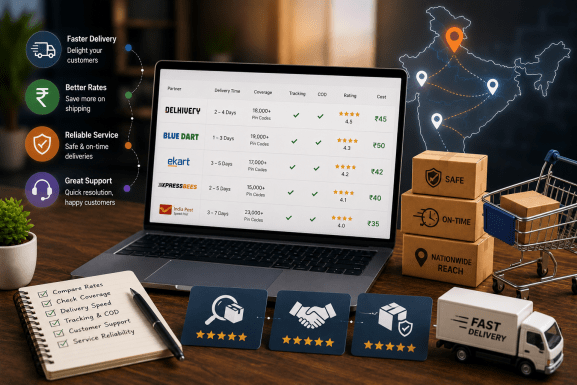
Price grabs attention first, but it's rarely the whole story. A slightly pricier courier that delivers reliably to your customers' pin codes will earn you more repeat business than a cheap one that loses parcels. Weigh coverage, speed, damage rates, and support alongside cost.
Pin code coverage is huge in India. A courier might be excellent in metros but weak in tier-2 and tier-3 towns where much of your growth lives. Always check whether your top delivery areas are well served before you commit.
Quick Facts: Shipping Decisions
| Top priority | Pin code coverage for your buyers |
| Cost driver | Weight, dimensions, and zone |
| COD remittance | Usually 2–8 days after delivery |
| RTO risk | Higher on COD, watch it closely |
| Volumetric weight | Charged when bulk exceeds actual weight |
| Best for wide reach | Aggregator with multiple couriers |
| Best for volume | Negotiated direct courier rates |
Aggregator vs Direct Courier
| Factor | Aggregator |
|---|---|
| Pin code reach | Very wide, many couriers combined |
| Setup effort | Low, one dashboard for everything |
| Best volume pricing | Good, but margins shared |
| Support ownership | Single point of contact |
For most small and growing stores, an aggregator is the easier starting point. It gives you reach and rate comparison without negotiating separate contracts. As your volume climbs, direct courier deals can shave costs on your busiest lanes.
Don't ignore returns and RTO
Return to origin (RTO) is a silent margin killer, especially with cash on delivery. You pay to ship the parcel out and pay again to get it back, with no sale to show for it. Choose a partner with solid RTO handling, and nudge customers toward prepaid with UPI to cut refusal rates.
Common Shipping Mistakes to Avoid
- Chasing the lowest rate while ignoring damage and delivery success.
- Forgetting volumetric weight, then getting surprise billing on bulky items.
- Offering only COD, which raises RTO and delays your cash flow.
- Not checking pin code coverage for your actual customer base.
- Skimping on packaging and eating the cost of damaged returns.
Frequently Asked Questions
1. Should I use an aggregator or a single courier?
Most small stores start with an aggregator for wider reach and easy rate comparison. Move to direct courier contracts once your volume is high enough to negotiate better rates.
2. What is volumetric weight?
It's a weight calculated from a parcel's dimensions. If your item is light but bulky, couriers charge on volumetric weight instead of actual weight, so pack efficiently.
3. How can I reduce RTO?
Encourage prepaid orders through UPI, confirm addresses at checkout, verify phone numbers, and send order updates. Fewer failed deliveries means healthier margins.
4. How fast should COD money reach me?
Remittance usually takes a few days to a week after delivery. Faster COD payout helps your cash flow, so it's worth comparing when choosing a partner.
5. Does packaging really affect shipping cost?
Yes. Oversized boxes raise volumetric weight and cost, while weak packaging leads to damage and expensive returns. Right-sized, sturdy packaging saves money both ways.
6. Can I offer prepaid payments to cut COD risk?
Absolutely. Accepting UPI and cards on your storefront pushes customers toward prepaid, which reduces refusals and speeds up your cash. A store that accepts UPI easily nudges buyers away from COD.
Conclusion
The right shipping partner isn't just the cheapest one. It's the one that reaches your customers reliably, handles returns fairly, and pays out COD without dragging your cash flow. Compare coverage, speed, and total cost, not just the sticker rate.
Shipping also depends on what happens before dispatch. When your storefront makes it easy to accept prepaid UPI payments and keeps orders organised, you ship faster and refuse fewer parcels. See how Webilns helps you run storefront, payments, and orders in one place, and check pricing when you're ready.
Get shipping right and every other part of your store feels smoother. Your customers judge you on the doorstep, so make that moment count.